

Gmail alternative: Backbuild Mail vs Gmail
Backbuild Mail includes email at your own domain free on every plan with a guided DNS setup, a mailbox for every member, outbound mail through your own Resend account, with the key held in a vault, and a public REST API with native MCP tools, inside the free Backbuild workspace. Gmail is the market-leading webmail service, with best-in-class search, mature spam filtering, polished mobile apps, and Gemini AI, and email at a custom domain on a paid Google Workspace plan.
The short answer
Gmail is Google's webmail app inside the Google Workspace suite, so on the Backbuild side that job is done by Backbuild Mail together with the workspace that surrounds it: Backbuild Docs, Sheets, Slides, Calendar, Contacts, Files, Finances, the helpdesk, and the Secrets vault, all under one account with governance and a public API on every plan. Gmail is a deep, mature, near-universally-adopted product, and it leads on search, spam filtering, ecosystem breadth, mobile apps, offline access, and a huge free consumer tier. Backbuild Mail fits teams and businesses that want their own domain without a per-user subscription, a mailbox for every member, sending through their own Resend account, and mail their software and AI agents can drive, with single sign-on, role-based access, and a tamper-evident audit log on every plan; shared-mailbox delegation is coming soon. A buyer whose first requirement is provider-blind, end-to-end encrypted mail should read the Proton Mail comparison instead, since neither Gmail nor Backbuild Mail is zero-access.
Backbuild Mail vs Gmail: feature by feature
Prices and limits below are quoted from each vendor's own pages, observed 2026-07-20. Google Workspace bills per user; annual billing prices are shown. The highlighted column is Backbuild Mail.
| Backbuild Mail Email at your own domain in the free workspace Free on every plan; workspace from $19/seat Get Started Free | Gmail Google's webmail, in Google Workspace Consumer Gmail free; Business Starter $7, Standard $14 per user/mo annual | |
|---|---|---|
| Price and access | ||
| Starting price | Free, up to 50 team members | Free consumer; business from $7/user/mo |
| Email at your own domain on the free plan | 2 domains free; unlimited paid | Paid Workspace only |
| Free consumer email at scale | Workspace-oriented free plan | |
| Free-plan sending | Through your own Resend account; no Backbuild send charge | Consumer daily send limits |
| Free-plan storage | 1 GB, then usage credits | Up to 15 GB, shared across Google services |
| Mailboxes for the whole team on the free plan | Auto-provisioning policies per member | Paid Workspace, per user |
| Search, spam, and organizing | ||
| Server-side full-text search of the message body | ||
| Best-in-class search at very large scale | Server-side full-text index | |
| Natural-language AI search across the mailbox | Gemini search | |
| Mature machine-learning spam and phishing filtering | ||
| Folders, labels, and server-evaluated filters (Backbuild filters re-run over existing mail through the REST API) | ||
| Undo send, scheduled send, and snooze Soon | Coming soon | |
| Reader privacy on remote images (the sender's tracking pixel does not see your IP address or location) | Signed server-side image proxy | Image proxy |
| Security and privacy | ||
| Encrypted in transit (TLS) and at rest | ||
| End-to-end and zero-access encryption of the mailbox (the provider cannot read stored mail) | ||
| Client-side encryption for regulated data | Enterprise plans | |
| Confidential mode: expiring, no-forward messages | ||
| Outbound through your own Resend account, key held in a zero-knowledge vault (never echoed back) | ||
| Published third-party attestations (SOC 2 Type II, ISO 27001, HIPAA BAA) | Not yet third-party audited | |
| Identity, governance, and administration | ||
| Single sign-on | Free, every plan | Business plans and admin config |
| SCIM provisioning Soon | Automated provisioning, admin config | |
| Role-based access control across the workspace | Admin roles | |
| Tamper-evident audit log on every plan | Google Vault, Business Plus and up | |
| Retention, hold, and eDiscovery | Server-side search over retained mail | Google Vault |
| Shared team mailboxes with read and write grants Soon (support@ worked by several people) | Coming soon | Groups Collaborative Inbox |
| Auto-provisioned mailboxes for organization members | Admin creates each account | |
| Domains and deliverability | ||
| Guided DNS setup with read-back verification (Backbuild: ownership, MX, and DMARC; outbound SPF and DKIM come from your Resend account) | ||
| Automatic DNS provisioning on a Cloudflare-connected domain | ||
| Send through your own Resend account, routed by category | ||
| Self-test a sending route end to end | ||
| AI, agents, and the API | ||
| Public REST API across the whole mail surface (mailboxes, messages, labels, filters, attachments, domains) | Gmail API | |
| Native MCP tools an AI agent can call | Google Workspace MCP server | |
| The whole surface driven under organization roles and a tamper-evident audit log | Admin audit in Vault, Business Plus and up | |
| Built-in AI writing assistance | AI assistant, every plan | Gemini in Gmail |
| Bring your own AI provider and model | Bundled Gemini models | |
| Workspace automations and custom AI skills on every plan (they drive mail through the REST API) | Apps Script | |
| Clients and migration | ||
| Web app | ||
| Desktop app (Windows, macOS) | Free | |
| Native mobile apps in the app stores today | Built; store rollout in progress | |
| IMAP, POP, and SMTP with a third-party mail client | ||
| Offline mailbox | ||
| Migrate mail in from Gmail or Outlook | Data migration tooling | |
| Thousands of third-party integrations in a marketplace | REST API and MCP tools | Google Workspace Marketplace |
| Workspace apps in the same subscription | ||
| Backbuild Mail (Google's similar offering: Gmail, compared row by row throughout this table) | Gmail | |
| Backbuild Chat (Google's similar offering: Google Chat) | Every plan, including Free | Google Chat |
| Backbuild Meetings (Google's similar offering: Google Meet video meetings) | Your organization’s members | Google Meet |
| Backbuild Calendar (Google's similar offering: Google Calendar) | Google Calendar | |
| Two-way sync with Google Calendar, Microsoft 365, and CalDAV Soon | Coming soon | |
| Appointment booking pages Soon | On the roadmap | Appointment schedules |
| Backbuild Contacts (Google's similar offering: Google Contacts) | Google Contacts | |
| Backbuild Docs (Google's similar offering: Google Docs) | Google Docs | |
| Native LaTeX format with live math and an editable source view | ||
| Offline editing and the more mature real-time collaboration | ||
| Backbuild Sheets (Google's similar offering: Google Sheets) | Google Sheets | |
| In-cell LaTeX math | ||
| Interactive pivot tables, the Apps Script ecosystem, and offline editing | ||
| Backbuild Slides (Google's similar offering: Google Slides) | Google Slides | |
| Native LaTeX slide decks on the Docs editor | ||
| Backbuild Diagrams Soon | On the roadmap for every plan | |
| Backbuild Photos (Google's similar offering: Google Photos) | Google Photos | |
| Non-destructive layer photo editor | ||
| Automatic phone backup, machine-learning search, and face grouping | ||
| Video, training video, audio, and music editors (in Backbuild Studio) | Training video renders today; the other editors export in the browser | |
| Backbuild Files (Google's similar offering: Google Drive) | Google Drive | |
| Edit stored photos and media in place with built-in editors | ||
| Mature desktop sync client and large low-cost storage tiers | ||
| Backbuild Finances (double-entry accounting, invoicing, bills, and bank reconciliation) | ||
| Helpdesk (tickets, workflow states, assignment, and replies) | 20 tickets/mo Free; unlimited paid | |
| Zero-knowledge Secrets vault (post-quantum, credentials the AI never reads in plaintext) | ||
A cross means the product does not offer the feature today. Soon means the feature is on the Backbuild roadmap and not shipped yet. Google Workspace prices and gating are quoted from the Google Workspace pricing page and a dated third-party pricing summary, observed 2026-07-20; monthly billing runs above the annual figures shown, and several Google controls such as Vault audit and eDiscovery are gated to Business Plus and Enterprise. In the workspace apps group, each row is one app in the Backbuild subscription; where Google has a similar offering, the row note names it and the indented rows beneath list the features that differ, in both directions.
Email at your own domain: what each plan includes
The most common reason people search for a Gmail alternative is the cost of email at a custom domain. Consumer Gmail is free, but only at an address ending in gmail.com; email at your own domain requires a paid Google Workspace plan, starting at Business Starter at 7 US dollars per user a month billed annually, so a five-person team pays 35 US dollars a month before anything else. Backbuild Mail includes email at your own domain on every plan, including free, with two linked domains and a wizard that sets up and verifies the inbound routing and DMARC records by reading back what is actually published, writing them automatically on a Cloudflare-connected domain, and outbound mail sends through your own Resend account, which supplies the SPF and DKIM records. The trade is real in both directions: the paid Google Workspace seat also buys the wider Google ecosystem, mature mobile apps, and offline access, which the free Backbuild plan reaches differently.
Governance on every plan versus governance by tier
Both products carry a full identity and governance surface, and Google Workspace is a broad, mature suite with strong administration. The difference is where the controls sit. Backbuild ships single sign-on, SCIM user provisioning (coming soon), role-based access control, and a tamper-evident audit log on every plan, including Free, with every mailbox action attributed and written in the same transaction as the operation it records. Google gates several of the equivalent controls by tier: single sign-on and automated provisioning are configured through the admin console on business plans, and Google Vault, which provides audit, retention, and eDiscovery, is available on Business Plus and Enterprise or as an add-on. For a small team that still wants attribution and least-privilege access, the on-every-plan model removes a tier upgrade; for a large enterprise, Google Vault and the Admin console are a deep, established estate that Backbuild does not yet match.
The API, MCP tools, and AI agents
Programmatic mail is a genuine parity point between these two products, not a Backbuild-only advantage, and it is worth stating plainly. The Gmail API is mature and free, with read, write, search, and draft access over OAuth, and Google shipped an official Google Workspace MCP server in 2026 with Gmail tools an AI agent can call. Backbuild answers with the same shape: the whole mail surface over a public REST API, and domain and mailbox provisioning as native MCP tools. The difference is in the surround. On Backbuild, the API and MCP surface is unified across the entire workspace under the same organization roles and permissions as the app, with every action recorded in a tamper-evident audit log on every plan, and the AI behind an agent runs on your own AI provider and model, or on Backbuild usage credits, rather than a bundled model. Google Workspace centralizes admin audit in Google Vault on Business Plus and Enterprise, and Gmail AI runs on Google's bundled Gemini models.
Common Gmail frustrations and how Backbuild Mail addresses them
Paying per user for your own domain
Email at a custom domain requires a paid Google Workspace plan from 7 US dollars per user a month. Backbuild Mail includes email at your own domain on every plan, including free, with two linked domains and a wizard that sets up and verifies the DNS for receiving.
Shrinking free storage that can lock the inbox
Google account free storage is changing to up to 15 GB shared across Gmail, Drive, and Photos, and going over quota can stop Gmail from sending or receiving. The Backbuild free plan starts at 1 GB, with overage on usage credits rather than a hard wall.
Setting up sending authentication yourself
Google requires senders to authenticate with SPF, DKIM, and DMARC, and now actively rejects unauthenticated mail, which legitimate small senders often trip over. Backbuild Mail runs a guided wizard that sets up and verifies the inbound routing and DMARC records, automatically on a Cloudflare-connected domain, and outbound mail is signed by your own Resend account, with its key held in a vault, once you verify the domain there.
AI locked to one bundled model
Gmail AI runs on Google's bundled Gemini models. Backbuild lets the organization bring its own AI provider and model, or run on usage credits, so inference runs under a provider agreement the organization controls.
Per-user pricing that multiplies
Google Workspace is priced per user a month, so cost grows linearly with the team. The Backbuild workspace is included on the free plan for up to 50 members, with a mailbox provisioned automatically for each member.
Where Gmail leads today
Gmail is a deep, mature product with strengths that are real and, in several areas, best-in-class. Its search is widely regarded as the best in email and now adds Gemini natural-language search and AI writing help. Its spam and phishing filtering reflects more than a decade of machine learning at enormous scale, a bar Backbuild Mail does not claim to match. Around the inbox sit capabilities Backbuild Mail does not offer today: IMAP, POP, and SMTP for third-party clients, an offline mailbox, Confidential mode, built-in mail migration, and mature native mobile apps. The wider platform adds the Google Workspace Marketplace with thousands of integrations, Google Meet and Google Chat, Google Vault for audit and eDiscovery, and a large set of published compliance attestations, alongside a free consumer tier used by a large share of the world. Buyers whose requirements center on these capabilities have a concrete reason to stay with Gmail.
Which tool wins, by use case
Freelancers and solo founders who want email at their own domain
A freelancer wants a credible address at their own domain, cheaply, and the back office around it. Backbuild Mail includes the own-domain mailbox free, with a wizard that sets up and verifies the inbound routing and DMARC records by reading back what is published, outbound mail signed by the freelancer's own Resend account, and the same free workspace covers invoicing and accounting and the calendar. Gmail reaches the same custom-domain address on a paid Google Workspace seat from 7 US dollars a month, and in exchange the freelancer gets mature mobile apps, offline access, and the Google ecosystem. The pause for a Backbuild choice here is migration and mobile: Google has a built-in importer for an existing archive and shipped mobile apps, where Backbuild has no import tool today and its mobile apps are still rolling out to the stores.
Small business teams and the shared support@ inbox
A team's mail needs are structural: everyone gets an address, support@ and billing@ are worked by several people, and leavers must lose access cleanly. Backbuild Mail covers the first and the last: provisioning policies create a mailbox for each member automatically, and access ends with organization membership, with single sign-on, roles, and audit on every plan. It does not yet cover the middle: there is no control yet to delegate a mailbox to teammates, so a team works support@ through a virtual worker or the Backbuild help desk until shared-mailbox delegation ships. Google Workspace provides per-user addresses on its business plans and handles shared support through Google Groups Collaborative Inbox, which works but differs from a real shared mailbox, plus the depth of the Google ecosystem and migration tooling for the cutover.
Power users with years of mail and heavy search
Someone with a decade of correspondence lives by search, and this use case leans to Gmail. Gmail search is best-in-class at very large scale, and Gemini adds natural-language queries phrased in plain English, with a built-in importer to bring the archive in and offline access for reading on the move. Backbuild Mail is competent here rather than dominant: its server-side index reads the whole body of every message and answers word, subject:, and single-filter searches such as has:attachment, identically from every device, which covers the everyday find-old-mail job, but it does not match Gmail scale or offer natural-language search, and it has no import tool to bring an old archive in.
Developers and automation teams who script their mail
For anyone who treats the mailbox as infrastructure, both products offer a real programmatic surface, so the decision turns on the surround. Backbuild exposes every mail operation over the public REST API and provisioning over native MCP tools, documented in the API reference, with a self-test mailbox to verify a sending route from a script and outbound routing through your own Resend account, whose key lives in the vault and is never echoed, all under organization roles and a tamper-evident audit log on every plan. Gmail answers with a mature, free API and an official MCP server, backed by a far larger integration ecosystem and years of tooling, though its centralized admin audit sits in Google Vault on higher tiers.
Privacy-first personal email
Neither product is built for the buyer whose defining requirement is that the provider be technically unable to read stored mail. Both Gmail and Backbuild Mail hold the keys to the mailbox and read message bodies, which is what makes Gmail search and Backbuild server-side search work. A person who wants zero-access, provider-blind email should look at a provider designed for that model; the Proton Mail comparison covers that trade in full.
Security-sensitive and regulated organizations
The two products present different governance stories. Google offers a deep, established estate: Google Vault for audit, retention, and eDiscovery, client-side encryption on Enterprise plans, and a large set of published compliance attestations including SOC 2, ISO 27001, and a HIPAA BAA, though the audit and eDiscovery controls are gated to higher tiers. Backbuild offers the access-control surface on every plan: single sign-on, role-based access, and a tamper-evident audit log free from the start, SCIM user provisioning (coming soon), per-organization isolation with every mailbox action attributed, and a zero-knowledge, post-quantum Secrets vault that keeps credentials beyond provider reach, although Backbuild is not yet third-party audited.
The daily inbox experience
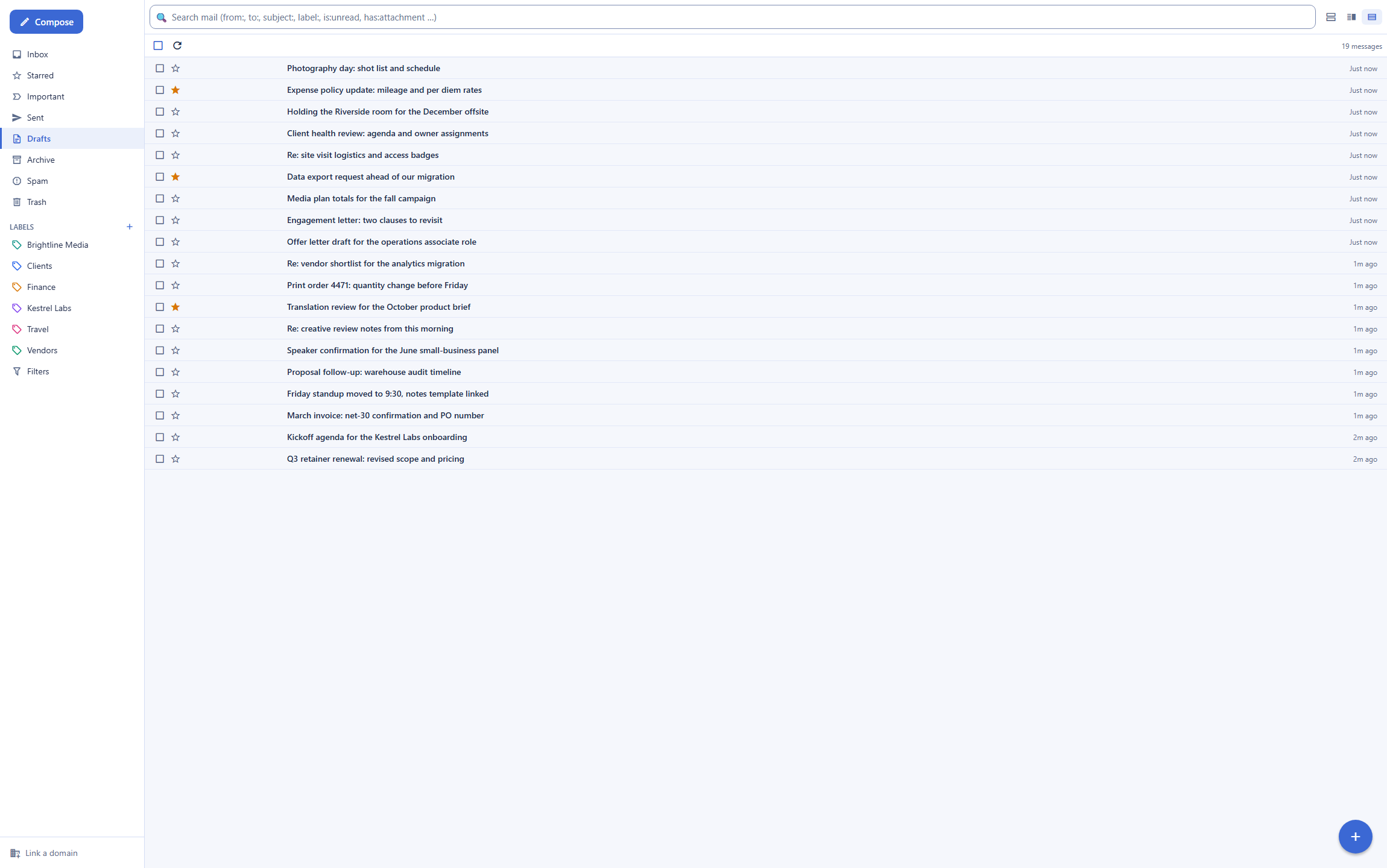
A person evaluating these two products for daily use is comparing the inbox loop: finding mail, writing mail, and staying organized. On finding, Gmail leads: its search is best-in-class at scale and adds natural-language Gemini search, while Backbuild Mail runs a server-side full-text index that answers words, subject:, and single filters such as is:unread, label:, and has:attachment, competent for the everyday find-old-mail job but not at Gmail depth or scale, and without sender, date, or combined searches yet. On writing, Gmail offers undo send, scheduled send, and snooze (Gmail undo runs up to 30 seconds), which Backbuild Mail does not offer yet, and both offer AI writing help, Gmail through Gemini and Backbuild through an assistant on your own model.
On staying organized, both provide labels, folders, and server-side filters, and Backbuild adds filters that re-run over existing mail through the REST API and a reading pane that can sit below, beside, or off, with keyboard triage. Where Gmail's daily experience is clearly stronger: its iOS and Android apps are mature and shipped while Backbuild's mobile apps are built and still rolling out to the stores, and Gmail reads mail offline, which Backbuild Mail does not. The daily bottom line: Gmail gives the deeper search and the polished mobile and offline loop, while Backbuild Mail gives a competent find-and-file loop on any device with a browser, at your own domain, inside a wider workspace.
Rolling it out across a team
The person who moves a team onto a mail system answers for onboarding, shared addresses, and leavers. On onboarding, Backbuild provisioning policies create a mailbox for each member automatically once the domain wizard has verified DNS, and the free desktop app covers members who want an installed client. On Google Workspace, an administrator creates each account in the Admin console, with built-in data migration pulling each member's old mail in, a genuine advantage during the cutover month since Backbuild has no import tool today.
On shared addresses, Google has an answer today and Backbuild does not yet: Google handles the pattern through Groups Collaborative Inbox, while Backbuild Mail has no control yet to delegate a mailbox, so a team runs a shared address through a virtual worker or the help desk until shared-mailbox delegation ships. On leavers, Backbuild access ends with organization membership under role-based access control, and the audit log carries the deprovisioning evidence on every plan; Google administrators suspend the account in the Admin console, with Vault retaining the mail on higher tiers. The rollout bottom line: for a team whose budget favors governance included and a mailbox for every member, Backbuild's provisioning model does the structural work; for a team that needs a shared address worked by several people now, or values the Google ecosystem, mature apps, and built-in migration, Google Workspace is the smoother landing.
Security, identity, and data governance evaluation
A security review of a mail platform turns on the threat model, identity controls, and evidence. On the threat model, neither product removes the provider from the trust boundary: both hold the keys and can read stored mail, so a program that requires provider-blind storage should look elsewhere. Within the key-holding model, Google offers deep tenant controls, client-side encryption for regulated data on Enterprise, and published third-party attestations, while Backbuild adds inbound HTML sanitization and a signed image proxy that hides the reader's IP and a zero-knowledge, post-quantum vault for credentials.
On identity, Backbuild ships single sign-on on every plan including Free with SCIM 2.0 user provisioning (coming soon), where Google configures single sign-on and provisioning on its business plans through the Admin console. On evidence, the ledgers differ: Backbuild's audit log is tamper-evident, written in the same transaction as the operation it records, and free on every plan, while Google centralizes audit, retention, and eDiscovery in Google Vault on Business Plus and Enterprise. On external validation, Google leads clearly with its SOC 2, ISO 27001, and HIPAA BAA posture, where Backbuild is built to those frameworks but not yet third-party audited. On AI governance, Backbuild lets the organization bring its own AI provider, so inference runs under the organization's own provider agreement, where Gmail AI runs on Google's bundled Gemini models. A reviewer who must certify vendor attestations and needs Vault-grade eDiscovery today leans Google; a reviewer building least-privilege access with provisioning, attribution, and a customer-controlled AI model on every plan leans Backbuild.
The economics for a finance and procurement review
The cost comparison has three parts: what mail costs, what forces upgrades, and what the choice displaces. On the mail itself, Backbuild Mail is free on every plan, including email at the company's own domain, with outbound mail sent through the company's own Resend account, which Backbuild does not charge for; the workspace itself is included on the free plan, and paid plans run 19 to 149 US dollars per seat a month. Google Workspace is per user: Business Starter at 7 US dollars and Business Standard at 14 US dollars per user a month billed annually, with Business Plus and Enterprise above them, and monthly billing priced higher. Consumer Gmail is free at a gmail.com address, a genuine advantage for individuals who do not need a custom domain.
On upgrade pressure, the item that moves a Gmail user to a paid Google Workspace plan is chiefly the custom domain and the per-user seat, with Vault audit and eDiscovery and more storage pushing further up the tiers; on Backbuild the corresponding items are free, and the meters that do scale, session minutes and storage beyond the free allowance, are usage-priced, while outbound mail goes through the company's own Resend account. On displacement, Backbuild's same subscription includes accounting and invoicing, the calendar, a secrets manager, and a helpdesk; Google Workspace includes Google Meet, the Drive storage economics, and the Marketplace, strong value for a team already standardized on Google. AI is structural: Gmail bundles Gemini, while Backbuild passes AI through at the customer's own provider rate or usage credits, a line procurement can price against an existing AI vendor agreement.
Strategic fit and vendor considerations
The strategic question is which platform bet each product represents. Gmail is part of Google Workspace, one of the most widely adopted and mature productivity suites in the world: a huge free consumer base, a deep integration marketplace, best-in-class search, a large compliance estate, and years of reliability at scale. An organization already standardized on Google, or one that values ecosystem breadth and a long track record, is squarely in its center of gravity. Backbuild is a workspace platform in Early Adopter Alpha whose mail client is one surface among Backbuild Mail, Chat, Meetings, Calendar, Contacts, Docs, Sheets, Slides, Diagrams, and Photos, the photo, video, training video, audio, and music editors, Files, Backbuild Finances, and the helpdesk, with a public REST API and an MCP tool surface positioning every one of those surfaces, mail included, as programmable infrastructure for software and AI agents.
Maturity and continuity run differently on each side. Google's product is established, its apps are shipped and polished, and its ecosystem is vast; the tradeoff is per-user pricing, tier-gated governance, and a single bundled AI model. Backbuild's platform is young: several workspace members are marked Soon on the pricing page, mobile distribution is still rolling out, automatic spam filtering is not available yet, third-party audits are not yet in hand, and shared-mailbox delegation is coming soon; the tradeoff buys a free custom domain, governance on every plan, sending through your own Resend account, a bring-your-own AI model, and a consolidated workspace. An organization betting on ecosystem breadth and a proven track record is betting with Google; an organization betting on consolidation, governance included, and agent-operated work is betting with Backbuild's roadmap.
Frequently asked questions
What is the best Gmail alternative for business?
It depends on what the business needs. Backbuild Mail is the strongest fit for a business that wants email at its own domain without a per-user subscription and mail that software and AI agents can drive, because it includes custom-domain email, a mailbox for every member, a public REST API, and single sign-on with audit logging on the free plan. Gmail remains the strongest fit for a business that wants the most mature product on the market: best-in-class search, decades of spam filtering, the wider Google Workspace ecosystem, mature mobile apps, and offline access. Compare the two feature by feature above and pick against the specific requirement.
Is there a free Gmail alternative with a custom domain?
Yes. Backbuild Mail includes email at your own domain on every plan, including free, with two linked domains and a guided wizard that sets up and verifies the DNS for receiving, with outbound mail sent through your own Resend account. Consumer Gmail is free but only at an address ending in gmail.com; email at your own domain requires a paid Google Workspace plan, which starts at 7 US dollars per user a month billed annually.
Is Backbuild Mail cheaper than Google Workspace?
For email at your own domain, yes. Backbuild Mail includes custom-domain email free on every Backbuild plan, where Google Workspace charges per user a month for the same: Business Starter at 7 US dollars and Business Standard at 14 US dollars per user a month billed annually, with Business Plus and Enterprise above them. The wider Backbuild workspace is included on the free plan as well, and paid Backbuild plans start at 19 US dollars per seat. Google Workspace does include capabilities Backbuild Mail does not, so the cost comparison should be read alongside the feature matrix rather than on price alone.
Does Backbuild Mail filter spam as well as Gmail?
No. This is one of the clearest places Gmail leads. Gmail applies more than a decade of machine-learning spam and phishing filtering at enormous scale, and it is widely regarded as best-in-class. Backbuild Mail gives every mailbox a Spam folder, but it does not yet sort spam or phishing into it automatically. A team whose top priority is the strongest available inbound spam and phishing defense should weigh that difference carefully.
Can Backbuild Mail search my email as well as Gmail?
Backbuild Mail keeps a server-side full-text index, so search reads the subject, the sender, and the whole message body, from any device, and also takes subject: and single filters such as label:, is:unread, and has:attachment. Searches by sender address or date, and combined searches, are not supported yet. That covers the everyday find-old-mail job. Gmail search is deeper: it is best-in-class at very large scale and now adds Gemini natural-language search that answers questions phrased in plain English. For a mailbox with years of correspondence and complex queries, Gmail search is the stronger tool today.
Does Backbuild Mail have an API like the Gmail API?
Yes, and this is a genuine parity point rather than a Backbuild-only advantage. The whole Backbuild mailbox and domain surface is available over a public REST API, and domain and mailbox provisioning is also exposed as native MCP tools an AI agent can call. The Gmail API is also mature and free, with read, write, search, and draft access, and Google shipped an official Google Workspace MCP server in 2026. The Backbuild difference is that the API and MCP surface is unified across the whole workspace under organization role-based access control and a tamper-evident audit log on every plan, and the AI behind an agent can run on your own AI provider and model.
Can my team share a mailbox like support@ or billing@ with Backbuild Mail?
Not by delegating a mailbox yet. Backbuild Mail has no control yet for a mailbox owner to give a teammate access, so today a mailbox is read by its owner; shared-mailbox delegation is coming soon. Teams run a shared address today by giving it to a virtual worker whose owner reads its inbox, or by working customer requests together in the Backbuild help desk. Google Workspace offers a related capability through Google Groups Collaborative Inbox, which lets a group of users manage messages sent to a group address, though it works differently from a true shared mailbox.
Can I move my existing Gmail mailbox into Backbuild Mail?
Not with a built-in importer today. Backbuild Mail does not yet offer a migrate-in tool that pulls an existing Gmail or Outlook archive into a new mailbox, and it does not expose IMAP or POP for a third-party client to copy mail across. Google, by contrast, provides data migration tooling for bringing mail into Google Workspace. If moving an existing archive in with a single tool is a hard requirement, that is a point in Gmail’s favor today.
Which is more private, Gmail or Backbuild Mail?
Neither is end-to-end encrypted by default, so neither is the right tool for a buyer whose defining requirement is that the provider be technically unable to read stored mail. Both Gmail and Backbuild Mail hold the keys to the mailbox and can read message bodies, which is what makes server-side search work on both, and spam filtering work on Gmail. A buyer who needs provider-blind, zero-access email should look at a provider built for that model; the Proton Mail comparison covers that trade in detail.
Try Backbuild Mail free
Email at your own domain on every plan, a guided DNS setup, server-side full-text search, a mailbox for every member, outbound routing through your own Resend account, a public REST API with native MCP tools, and single sign-on with audit logging, inside the free Backbuild workspace. If your priority is best-in-class search, mature spam filtering, undo and scheduled send, a shared inbox today, the Google ecosystem, and shipped mobile and offline apps, Gmail remains the stronger choice.
Get started with Backbuild Mail